
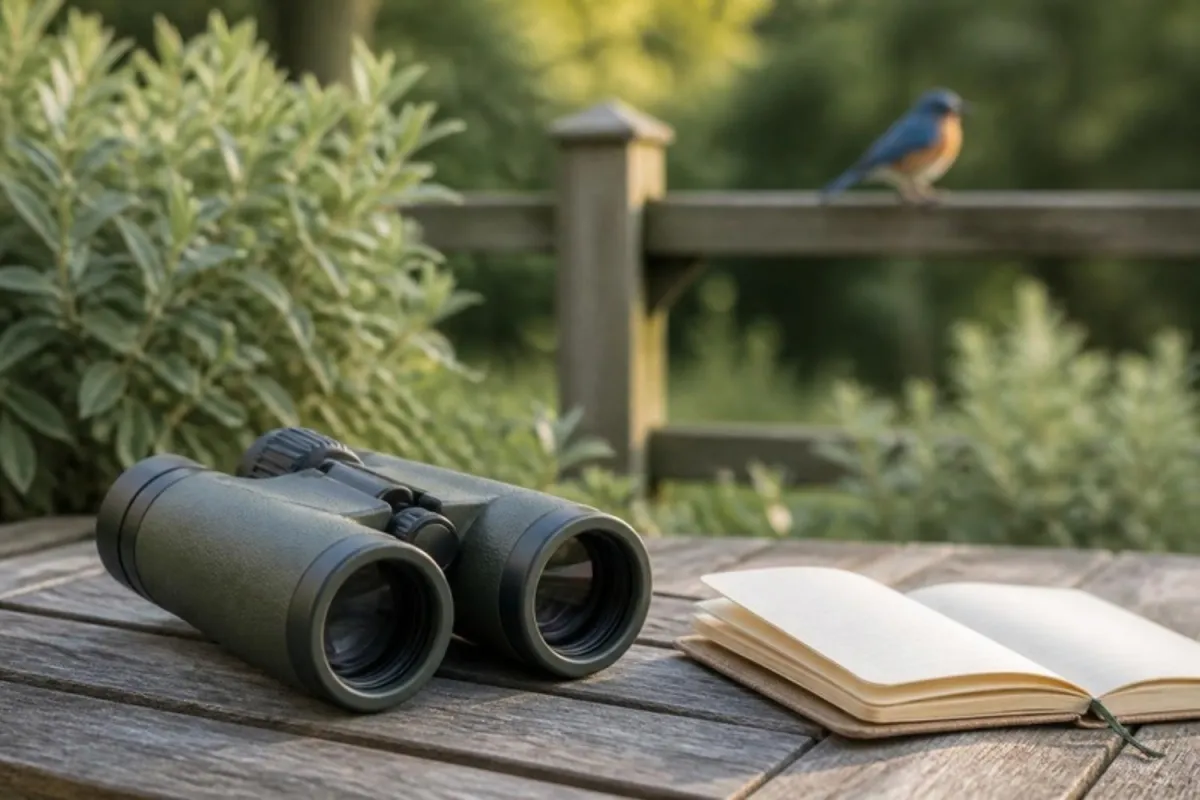
Binoculars are the single most important piece of birding gear. For most people, the best choice is an 8x magnification pair with a wide field of view, a short close-focus distance and waterproofing. Here’s how our picks compare.
Last reviewed October 10, 2026 · Recommendations are based on manufacturer specifications, published product documentation and established birding guidance — not hands-on lab testing. Our editorial policy.
Quick picks
- Best step-up pair (ED glass): Nikon MONARCH M5 8×42
- Best all-rounder with lifetime warranty: Vortex Diamondback HD 8×42
- Best value for beginners: Celestron Nature DX 8×42
- Best compact & lightweight: Nikon PROSTAFF P3 8×30
How we chose
We compared manufacturer specifications that matter most for birding: magnification, field of view, close focus, eye relief, weight, coatings, waterproofing and warranty. We favored 8x models because they’re easier to hold steady and aim. We haven’t lab-tested these binoculars; optical quality is also personal, so try a pair in person if you can.
| Product | Best for | Key features | Considerations | Shop |
|---|---|---|---|---|
| Nikon MONARCH M5 8×42Nikon | A step-up pair with ED glass for sharper, cleaner color |
|
| Check Price (opens Amazon in a new tab) |
| Vortex Diamondback HD 8×42Vortex Optics | All-round birding with a short close focus and lifetime warranty |
|
| Check Price (opens Amazon in a new tab) |
| Celestron Nature DX 8×42Celestron | Budget-friendly first binoculars for beginners |
|
| Check Price (opens Amazon in a new tab) |
| Nikon PROSTAFF P3 8×30Nikon | Compact, lightweight binoculars for travel and kids |
|
| Check Price (opens Amazon in a new tab) |
Our picks in detail
Best step-up pair Nikon MONARCH M5 8×42
Best for: A step-up pair with ED glass for sharper, cleaner color
ED glass is the most noticeable upgrade over entry-level binoculars when watching birds against bright sky. The 8x magnification keeps the view steady and the field wide enough to find moving birds.
What stands out
- ED (extra-low dispersion) glass to reduce color fringing
- Dielectric and phase-correction prism coatings
- Waterproof and fog-free (nitrogen filled)
- Wide 48.2° apparent field of view
Things to consider
- Close focus (about 8 ft) is longer than some birding-specific models.
- Full-size 42 mm pair — not the lightest to carry all day.
Manufacturer specifications
- Magnification
- 8x · Objective: 42 mm
- Field of view
- 112 m at 1,000 m (≈335 ft at 1,000 yd)
- Close focus
- 2.5 m (≈8.2 ft)
- Exit pupil
- 5.3 mm
- Weight
- 630 g (≈22.2 oz)
Source: imaging.nikon.com. Specifications can change between production runs — confirm on the product listing before you buy.
Best all-rounder Vortex Diamondback HD 8×42
Best for: All-round birding with a short close focus and lifetime warranty
A 5-ft close focus and a comfortable 8x view are exactly what backyard and trail birders use most, and the included harness makes it easy to carry. The warranty makes it a low-risk first serious pair.
What stands out
- HD optical system for color fidelity and edge sharpness
- Close focus of 5 ft — great for nearby birds and butterflies
- Argon-purged, O-ring sealed: waterproof and fogproof
- Unlimited, unconditional lifetime warranty
Things to consider
- Warranty covers repair or replacement, not loss or theft.
- Not ED-labeled like some pricier pairs.
Manufacturer specifications
- Magnification
- 8x · Objective: 42 mm
- Field of view
- 393 ft at 1,000 yd (7.5°)
- Close focus
- 5 ft
- Eye relief
- 17 mm
- Weight
- 21.8 oz
- Includes
- GlassPak harness, lens covers
Source: vortexoptics.com. Specifications can change between production runs — confirm on the product listing before you buy.
Best value Celestron Nature DX 8×42
Best for: Budget-friendly first binoculars for beginners
Phase-coated prisms and a short close focus are features that used to be found only on more expensive binoculars, making this a strong value for a first pair.
What stands out
- Phase-coated BaK-4 prisms and fully multi-coated lenses
- Close focus of about 6.5 ft
- Waterproof and fogproof
- Rubber-armored polycarbonate body
Things to consider
- Polycarbonate body feels less premium than metal-chassis pairs.
- Slightly narrower field of view than some competitors.
Manufacturer specifications
- Magnification
- 8x · Objective: 42 mm
- Field of view
- 388 ft at 1,000 yd (7.4°)
- Close focus
- 6.5 ft
- Eye relief
- 17.5 mm · Exit pupil: 5.25 mm
- Weight
- ≈629 g
Source: www.celestron.com. Specifications can change between production runs — confirm on the product listing before you buy.
Best compact Nikon PROSTAFF P3 8×30
Best for: Compact, lightweight binoculars for travel and kids
The lighter a pair is, the more often it actually comes along. The very wide field of view makes it easy to find birds — helpful for beginners and children.
What stands out
- Light at about 16.75 oz
- Very wide 456 ft field of view at 1,000 yd
- Waterproof and fogproof
- Compact roof-prism body
Things to consider
- Smaller 30 mm objectives gather less light than 42 mm at dawn and dusk.
- Shorter eye relief than some full-size pairs for eyeglass wearers.
Manufacturer specifications
- Magnification
- 8x · Objective: 30 mm
- Field of view
- 456 ft at 1,000 yd (8.7°)
- Close focus
- 8.2 ft
- Eye relief
- 15.4 mm · Exit pupil: 3.8 mm
- Weight
- 16.75 oz (475 g)
Source: www.nikonusa.com. Specifications can change between production runs — confirm on the product listing before you buy.
How to choose birding binoculars
8x or 10x?
8x gives a wider, brighter, steadier view — ideal for finding fast-moving songbirds. 10x shows more detail on distant birds but magnifies hand shake. Most birders start with 8x.
42 mm or 30–32 mm?
42 mm objectives gather more light for dawn, dusk and shady woods. 30–32 mm models are lighter and smaller — great for travel and kids.
Close focus
Backyard birds are often near. A close focus around 5–8 feet or less lets you study birds at a feeder or butterflies in the garden.
Eye relief for glasses
If you wear glasses, look for roughly 15 mm or more of eye relief and twist-down eyecups so you can see the full image.
Glass and coatings
Phase-coated roof prisms improve sharpness and contrast; ED glass reduces purple-green fringing around birds against a bright sky. Both are worth paying for if your budget allows.
Waterproof, fogproof and warranty
Nitrogen- or argon-purged bodies prevent internal fogging. A strong warranty protects your investment.
Using your binoculars
- Set the eyecups (down for glasses, up without).
- Adjust the hinge until you see one circle.
- Close your right eye and focus with the center wheel; then close your left eye and adjust the right diopter.
- Keep your eyes on the bird and bring the binoculars up to your eyes — don’t search through them.
Frequently asked questions
What do the numbers 8x42 mean?
8x is the magnification; 42 is the diameter of each front lens in millimeters.
Are expensive binoculars worth it?
Higher-end glass gives sharper edges, better color and brighter low-light views. Many birders find a mid-range pair the best balance.
Roof prism or porro prism?
Roof prisms are more compact and easier to waterproof, which is why most birding binoculars use them.