
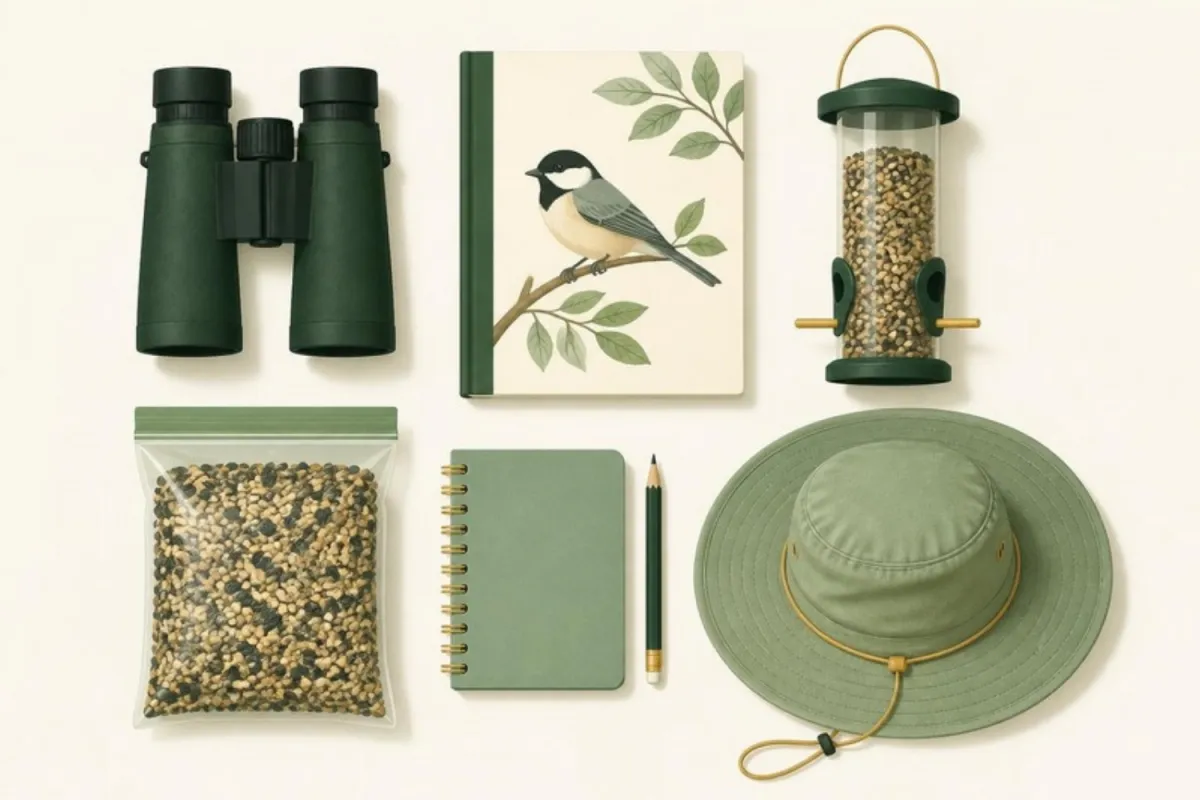
Birdwatching is one of the cheapest hobbies to start. You can begin today with nothing but your eyes and a window. But a few well-chosen items make it far more rewarding. Here’s the kit we’d suggest, in priority order.
Last reviewed October 10, 2026 · Recommendations are based on manufacturer specifications, published product documentation and established birding guidance — not hands-on lab testing. Our editorial policy.
1. Binoculars (the one essential)
Choose 8x magnification, waterproof, with a close focus of around 8 feet or less. An 8×42 is brighter; an 8×30 is lighter.
Celestron Nature DX 8×42
Celestron
Best for: Budget-friendly first binoculars for beginners
- Phase-coated BaK-4 prisms and fully multi-coated lenses
- Close focus of about 6.5 ft
- Waterproof and fogproof
- Rubber-armored polycarbonate body
Keep in mind: Polycarbonate body feels less premium than metal-chassis pairs. Slightly narrower field of view than some competitors.
Vortex Diamondback HD 8×42
Vortex Optics
Best for: All-round birding with a short close focus and lifetime warranty
- HD optical system for color fidelity and edge sharpness
- Close focus of 5 ft — great for nearby birds and butterflies
- Argon-purged, O-ring sealed: waterproof and fogproof
- Unlimited, unconditional lifetime warranty
Keep in mind: Warranty covers repair or replacement, not loss or theft. Not ED-labeled like some pricier pairs.
Nikon PROSTAFF P3 8×30
Nikon
Best for: Compact, lightweight binoculars for travel and kids
- Light at about 16.75 oz
- Very wide 456 ft field of view at 1,000 yd
- Waterproof and fogproof
- Compact roof-prism body
Keep in mind: Smaller 30 mm objectives gather less light than 42 mm at dawn and dusk. Shorter eye relief than some full-size pairs for eyeglass wearers.
Compare more in our binocular guide.
2. A field guide and a free app
A printed guide helps you learn the field marks that separate similar birds. Pair it with the free Merlin Bird ID app from the Cornell Lab for photo and sound ID, and eBird for keeping lists.
The Sibley Guide to Birds (2nd Edition)
David Allen Sibley · Knopf
Best for: A comprehensive North American reference with detailed illustrations
- Illustrations of plumage variations, sexes and ages
- More than 100 species added versus the first edition
- Range maps for each species
- 624 pages
Keep in mind: Large and heavy for the field — many birders keep it at home and carry a smaller regional guide or app.
3. A feeder and good seed
Bring birds to you with a tube feeder and black-oil sunflower seed — or a window feeder if you don’t have a yard.
Brome Squirrel Buster Plus
Brome Bird Care
Best for: Backyards with squirrels and birders who want cardinals at a tube feeder
- Weight-activated shroud closes the 6 feeding ports when a squirrel climbs on
- Included cardinal ring gives larger birds room to perch facing the food
- Large 5.1 lb seed capacity means fewer refills
- Seed ventilation system designed to help keep seed fresher
Keep in mind: Tall and fairly heavy when full — needs a sturdy hook or pole. Weight-activated feeders also exclude heavier birds such as doves and some jays; adjust expectations if you want them.
Nature Anywhere Window Bird Feeder
Nature Anywhere
Best for: Apartments, balconies and anyone who wants close-up views without a yard
- Four heavy-duty suction cups
- Sliding seed tray removes for easy cleaning
- Dual tray to offer two foods
- Clear polycarbonate for close viewing
Keep in mind: Suction cups need clean, smooth glass and may need re-seating in temperature swings. Small capacity means more frequent refills.
4. A notebook
Write down the date, place, weather, bird and behavior. Even simple notes sharpen your observation skills. A weatherproof notebook survives drizzle — browse weatherproof notebooks.
5. Nice-to-have extras
- Binocular harness — spreads the weight; browse harnesses.
- Bird bath — water attracts birds that skip feeders.
- Camera — once you’re hooked; see the Photography Gear Finder.
What to skip at first
- Spotting scopes — great later for water birds, but not essential.
- High-magnification or “zoom” binoculars.
- Cheap seed mixes full of filler.
Frequently asked questions
How much does it cost to start birdwatching?
You can start for free. A decent pair of binoculars is the main cost; check current prices on the retailer’s site for options at different budgets.
What are the easiest birds for beginners to learn?
Start with the common birds at your feeder — often cardinals, chickadees, finches, sparrows and doves in North America — then branch out.